What is security? / BSI
CIA Model for Security Goals (obviously not the end all be all)
Confidentiality:
- Keeping sensitive information protected
- Examples: passwords, personal data
Integrity:
- Ensuring only authorized entities can access or modify data the correct data
- Examples:
- Bank accounts
- E-boks (compromised by Netcompany)
- Personal accounts (Steam security incidents)
Availability:
- Critical systems must be accessible when needed
- Examples: NemID, medical records
- Note: This is somewhat debatable in certain contexts
Security as an Afterthought
Security is rarely the primary consideration in system design:
- Houses: Standard locks are easily compromised; windows prioritize light/views over security
- Bunkers: Contrast where security is the primary design concern
Software Security
Largely follows the same principles as physical security, applying CIA to digital systems, but obviously limited to software.
Risk Analysis & Management
Risk management involves understanding tradeoffs:
- Example: Home design balances aesthetics (windows at eye level) vs. security (higher windows or none)
Most systems initially prioritize functionality over security:
- Development often focuses on demonstrating working prototypes
- Security considerations are frequently deferred, leading to vulnerabilities
Secure C
Reflections on C’s “security” model • How and where (in the process) should it have been found? before the function was introduced. • How can it be mitigated/solved? adding a depricated warning • Are they C specific? (these examples are low level specific and exist in the compiler) • Can they be found using manual reviews? Static analyis? • Reflections on the importance of context when defining security (think microarchitecture attacks and “helpful” compilers)
STRCPY:
strcpy() in C does not perform bounds checking. This means that it doesn’t verify if the destination buffer is large enough to hold the source string, which can lead to a buffer overflow if the source string is larger than the destination buffer.
strcpy_s is considered safer than strcpy primarily because it helps prevent buffer overflows. Here’s why:
- Buffer Overflow Protection:
strcpy_srequires you to explicitly specify the size of the destination buffer. This allows the function to avoid writing beyond the buffer’s boundaries, preventing potential overflows.strcpydoes not perform this check, making it vulnerable to writing past the allocated memory if the source string is larger than the destination buffer.
strcpy() violates the following security rules:
- CWE-120: Buffer Copy without Checking Size of Input (‘Classic Buffer Overflow’) - strcpy performs no bounds checking, allowing buffer overflows when the source string exceeds destination capacity
- CWE-676: Use of Potentially Dangerous Function - strcpy is considered inherently dangerous
- CERT C STR31-C: “Guarantee that storage for strings has sufficient space for character data and the null terminator”
sprintf
sprintf has potential for buffer overflows because of bad bound checking like in STRCPY above.
- Buffer Overflow: The main issue with
sprintfis that it doesn’t perform bounds checking. If the formatted string exceeds the buffer size, it can lead to a buffer overflow, potentially overwriting adjacent memory and causing crashes or security exploits.
sprintf() violates the following security rules:
- CWE-120: Buffer Copy without Checking Size of Input (‘Classic Buffer Overflow’) - Like strcpy, it performs no bounds checking
- CWE-676: Use of Potentially Dangerous Function - It’s inherently dangerous due to buffer overflow risks
- CERT C STR31-C: “Guarantee that storage for strings has sufficient space for character data and the null terminator”
- CERT C FIO30-C: “Exclude user input from format strings” (if user input is used in the format string)
spectre/meltdown are very hard to avoid.
Formal methods
- Why do we need formal methods?
- Explicit State Reachability Checking
- Abstract Interpretation
- The Uninitialised Variable Analysis
- The sign analysis
Why do we need formal methods?
Formal methods are needed to find bugs in programs.
- Game bugs demonstrate real-world problems - from speedrunner-exploitable bugs to frustrating gameplay issues
- Testing limitations - We can’t test all possible inputs, and traditional testing requires partitioning inputs into groups with similar behavior
- Security implications - An error may be an attack vector, making verification crucial in security contexts
- Verification throughout development - Formal methods can be applied at different stages from requirements to implementation
Explicit State Reachability Checking
Explicit state reachability checking explores the complete state space by executing programs with concrete values . Key characteristics include:
- Worklist algorithm - Uses a systematic search through all reachable states starting from an initial state
- State explosion problem - The number of possible states grows exponentially (8-bit: 255 states, 32-bit: 4+ billion states)
- Search strategies - Can use breadth-first (queue), depth-first (stack), or random approaches
- Completeness vs. scalability - While theoretically complete, it may not terminate for large programs due to infinite state spaces
Abstract Interpretation
Abstract interpretation executes programs with abstract values rather than concrete values to achieve termination while maintaining soundness . The approach involves:
- Abstract domains - Replace concrete values with abstract representations that capture relevant properties
- Sound approximation - Results are guaranteed to be correct (no false negatives) but may produce false positives because it can only check some code
- Termination guarantee - By using finite abstract domains, the analysis is guaranteed to terminate
- Trade-off principle - “You can only have two” of soundness, completeness, and termination
The Uninitialised Variable Analysis
The uninitialised variable analysis uses abstract interpretation with a simple two-element domain :
- Abstract domain Di = {⊥, ⊤} where ⊥ represents “uninitialised” and ⊤ represents “initialised”
- Transfer functions - Variable assignments set values to ⊤, while uninitialized variables remain ⊥
- Purpose - Detects potential uses of uninitialised variables before they cause runtime errors
- Memory handling - Memory operations return ⊤ (assuming memory could contain any value)
The Sign Analysis
The sign analysis tracks the sign of integer values using a lattice-based abstract domain :
- Abstract domain Dsign = {+, -, 0, ⊤, ⊥} with partial ordering where ⊥ is bottom and ⊤ is top
- Arithmetic operations - Abstract addition, multiplication, and comparison operations are defined with lookup tables
- Example operations:
+ + + = +,+ + - = ⊤,+ + 0 = ++ * + = +,+ * - = -,+ * 0 = 0
- Applications - Can detect division by zero, array bounds violations, and other sign-related errors
- Precision vs. efficiency - More abstract than explicit values but can be extended (e.g., distinguishing +0 and -0) for increased precision
Access control models
Access Control Matrix
An access control matrix is a formal security implementation for an access control model that represents the permissions of subjects (users, processes) to perform operations on objects (files, resources) in a system.
Example of Access Control Matrix:
| Subject/Object | File1.txt | File2.doc | Printer1 | Database |
|---|---|---|---|---|
| Alice | Read, Write | Read | Read, Write | |
| Bob | Read | Read, Write | No Access | |
| Charlie | No Access | Read | No Access | Read |
| Admin | Read, Write, Execute | Read, Write, Execute | Manage | Read, Write, Admin |
- Each cell contains the access rights that a subject has on an object
- Implementation can be row-wise (capability lists) or column-wise (access control lists)
Lattice-Based Access Control
A lattice is a mathematical structure used to model security levels and information flow in a system.
Example Lattice Diagram:
            Top Secret
            /        \
       Secret        TS-A
       /    \        /   \
Confidential  S-A   S-B   TS-B
       \    /        \   /
        Public        C-A
subjects with Top Secret clearance can read everything below them in the hierarchy
- In this lattice:
- Top Secret (TS) is the highest classification
- Public is the lowest classification
- Some classifications are compartmentalized (e.g., S-A represents “Secret with A clearance”)
- Information can only flow from lower to higher levels or to incomparable levels
Finite State Machine Model
A finite state machine (FSM) model formally describes system behavior through states, transitions, and actions.
Example State Machine for File Access:
      ┌───────────┐     authenticate     ┌───────────┐
      │  Locked   │ ─────────────────>   │ Unlocked  │
      └───────────┘                      └───────────┘
           ↑                                   │
           │                                   │
           │          timeout/logout           │
           └───────────────────────────────────┘
States:
- Locked: File access is prohibited
- Unlocked: File access is permitted based on ACL
Transitions:
- authenticate: User provides valid credentials
- timeout/logout: Session expires or user logs out
Bell-LaPadula (BLP) Model5
The Bell-LaPadula model is a formal state machine security model focusing on maintaining confidentiality in systems.
Example BLP Scenario:
| Subject | Clearance | Object | Classification | Operation | Allowed? |
|---|---|---|---|---|---|
| User1 | Secret | DocA | Top Secret | Read | No (violates Simple Security) |
| User1 | Secret | DocB | Confidential | Write | No (violates *-Property) |
| User1 | Secret | DocC | Secret | Read | Yes (same level) |
| User1 | Secret | DocC | Secret | Write | Yes (same level) |
| User1 | Secret | DocD | Unclassified | Read | Yes (higher clearance) |
- Simple Security Property: User1 cannot read DocA because Top Secret > Secret
- *-Property: User1 cannot write to DocB because Confidential < Secret
- Both properties allow operations at the same security level
Web security
 www.example.com and example.com are not the same because www is just a subdomain.
port 4000 and 5000 are not the same origin since different ports often run different applications or services that should be isolated from each other
the part after the domain and port is the same origin, thats literally how websites work.
port 81 and port 80 (http) are not the same.
port 443 (https) and http (80) are not the same.
Security is fun when you make sure you do stuff properly
- the user is the enemy
- sanitise your data
- properly protect your routes
- protect your api
- Use a proper cryptographic library
- dont push your auth tokens
Also client side scripting is a thing.
Sanitize your data. Self-tweeting tweet. tweet deck read text as if it should be executed.
-
1xx (Informational): The request was received and understood.
-
2xx (Successful): The request was successfully received.
-
3xx (Redirection): Further action is required to complete the request.
-
4xx (Client Error): The request contains bad syntax or cannot be fulfilled.
-
5xx (Server Error): The server failed to fulfill an apparently valid request.
Fuzzing
What is Fuzzing?
Fuzzing is an automated testing technique that involves feeding invalid, unexpected, or random data as inputs to a program to discover bugs, crashes, and security vulnerabilities. The goal is to make the program behave unexpectedly or crash, which indicates potential security issues or bugs.
Blackbox Fuzzing
We only know that is crashes, put in random input and see what happens. If it doesnt crash then :thumbsup: if it crashes, then we know there is something we might want to handle.
Its hard because we dont know much, so knowing what to test and how to test is pretty problamatic which is where greybox fuzzing comes in since A Little Knowledge Goes a Long Way.
Greybox Fuzzing
it involves adding monitoring and measurement capabilities to software systems to gain insights and improve security. So if we know what part fails how it becomes a LOT easier to figure out what goes wrong and why. Fuzzing is great for detecting crashes and kinda garbage for Logic errors, which is why we try to get a little more information in greybox testing.
Whitebox Fuzzing
Whitebox fuzzing is pretty good for logic errors, but, REALLY tedious to make properly, and we all know the weakest link in the chain is the programmer.
Has a HUGE investment to do properly. • Requires difficult to use tools • Requires full access to source code • Requires working build system/platform (for target) • Instrumentation may change properties (e.g., timing
Generation vs Mutation-based Fuzzing
Generational Fuzzing
• Creates test inputs from scratch based on specifications or grammars • Knows the input format (like file headers, protocol structures) • More targeted but requires understanding of the input format • Example: Creating valid-looking PDF files with malicious payloads
Mutation-based Fuzzing
• Takes existing valid inputs and modifies them randomly • Easier to implement - just flip bits, change bytes, etc. • Less knowledge required about input format • Example: Taking a valid JPEG and randomly changing some bytes
Smart vs Dumb Fuzzing
Smart (Structured) Fuzzing
• Understands the input format/protocol structure • Uses grammars, specifications, or reverse-engineered formats • More likely to generate valid-ish inputs that get past basic parsing • Higher chance of finding deeper bugs but more complex to set up
Dumb (Unstructured) Fuzzing
• No understanding of input format • Just throws random garbage at the target • Super easy to implement and run • Good at finding basic parsing bugs but might not reach deeper code paths
Instrumentation
Instrumentation is the process of adding extra code or monitoring capabilities to a program to collect information about how it runs. In fuzzing context, instrumentation helps us see what the program is actually doing when we feed it our test inputs, rather than just “did it crash or not?”
Compiler-based Instrumentation
• Automatically adds coverage tracking code • Less manual work but requires recompilation • Examples: AddressSanitizer (ASan), coverage tracking in AFL
Manual Instrumentation
• Manually add monitoring code to source • More control over what gets monitored • Can track application-specific metrics • More work but can be more targeted
fuzzing improvements
Have some standard strings or whatever it should test. those things should be the most common things people get wrong. Essentially a common mistakes list it should go through. (yes i know it already exists but)
Injection attacks and taint analysis
Taint Analysis
Taint analysis tracks the flow of untrusted data through a program to identify potential security vulnerabilities.
Example of Taint Analysis in Code:
// Tainted input (untrusted)
String userInput = request.getParameter("username");  // TAINTED

// Unsafe operation (SQL Injection vulnerability)
String query1 = "SELECT * FROM users WHERE name = '" + userInput + "'";  // TAINTED

// Safe operation (using parameterized query)
PreparedStatement stmt = connection.prepareStatement("SELECT * FROM users WHERE name = ?");
stmt.setString(1, userInput);  // SANITIZED
In this example:
- The input from
request.getParameter()is considered tainted - Direct use of tainted data in SQL creates a vulnerability
- Using parameterized queries sanitizes the input
Uses for taint analysis
- Tracks untrusted data flow through applications to detect injection vulnerabilities
- Identifies SQL injection, XSS, and command injection risks
- Operates via static (code analysis) or dynamic (runtime) approaches
Limitations
- Misses implicit flows where tainted data affects control flow indirectly
- Struggles with custom sanitization recognition
- Context insensitivity issues - same data may be safe or dangerous depending on usage
- Performance overhead, especially in dynamic analysis
- High false positive/negative rates in complex applications
- Cannot detect sophisticated sanitization bypasses or logic-based vulnerabilities
Best practice: Use taint analysis as one component of a comprehensive security program rather than relying on it exclusively.
• Notes on how to design a (taint-like) analysis
- Look at all your inputs and outputs and pick the worst case. • Notes on how to solve flow equations (even recursive ones)
- you just have to repeat the analysis until it doesnt change anymore, and then you take all your ins and outs (paths) and pick the worst case of them.
What it is the work list algorithm: A generic graph traversal algorithm that systematically explores all states reachable from a starting point. It’s commonly used in computer science for tasks like model checking, program analysis, and graph exploration.
What it does:
- Starts with an initial state
s - Finds all states that can be reached by following transitions from the initial state
- Keeps track of visited states (
passed) to avoid revisiting them - Uses a worklist (
waiting) to manage which states still need to be explored
Key variations:
- Breadth-first search: Use a queue for
waiting(explores level by level) - Depth-first search: Use a stack for
waiting(explores deeply first) - Random: Choose states randomly from
waiting
Important notes:
- The algorithm always finds the same result regardless of search order
- Performance varies significantly depending on the search strategy chosen
- Terminates when the state space is finite and all reachable states have been found
Secure information flow
Non-Interference Definition & Concept
Core Definition
Non-interference ensures that high-security (H) inputs cannot affect low-security (L) outputs in any way.
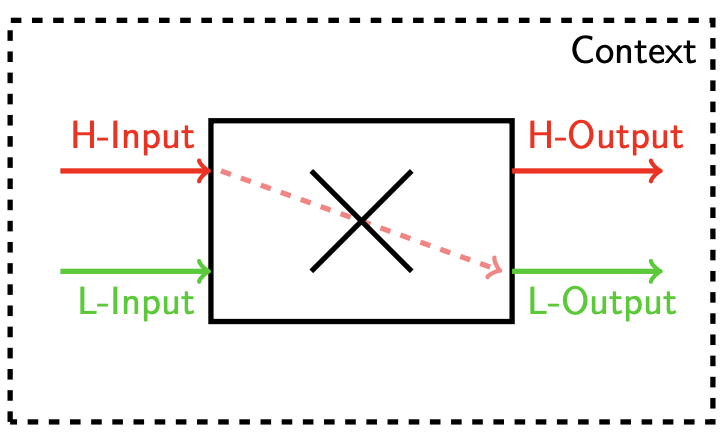
Formal Definition
Statement S is non-interfering if whenever:
⟨S,s₁⟩ → s'₁and⟨S,s₂⟩ → s'₂dom(s₁) = dom(s₂) = dom(Γ)s₁(x) = s₂(x)for all x whereΓ(x) ≤ ℓ
Then: s'₁(x) = s'₂(x) for all x where Γ(x) ≤ ℓ
Key Properties
- Very strong security guarantee - prevents all information leakage
- May be too restrictive for practical applications
- Captures the essence of confidentiality - secret data cannot influence public outputs
Confidentiality Attacks
Direct Flows
- Definition: Explicit assignment of high-security data to low-security variables
- Example:
x = input(HIGH); output(x); - Detection: Easy to detect with basic taint analysis
Indirect Flows (Implicit Flows)
- Definition: High-security data affects control flow, which influences low-security variables
- Example:
  x = input(HIGH);
  if (x) y = 0;
  else y = 1;a
output(y);- Challenge: Control flow dependency creates information leakage
- Detection: Requires tracking program counter (pc) taint
Side-Channels
- Definition: Information leakage through execution characteristics
- Examples:
- Timing channels: Execution time reveals secret information
- Memory access patterns: Cache behavior exposes data
- Resource consumption: CPU/memory usage patterns
- Challenge: Very difficult to prevent with static analysis alone
Defining Confidentiality in Programs
Classifying Variables
- Security Levels: Variables assigned security classifications
- Common Levels:
- H (High): Secret/confidential data
- L (Low): Public data
- Environment:
Γ: Var → Levelassigns security level to every variable
Security Lattice
- Structure:
SecLevel = ({H,L}, ⊑)whereL ⊑ H - Ordering: Low security ⊑ High security
- Join Operation:
L ⊔ H = H,L ⊔ L = L,H ⊔ H = H - Purpose: Determines information flow direction and constraints
Taint Analysis for Confidentiality
Basic Taint Analysis
- Purpose: Track flow of tainted (high-security) data
- Dataflow Problem:
SIF = Vars → SecLevel - Handles: Direct flows effectively
- Limitation: Cannot detect indirect flows
Extended Taint Analysis
Key Extensions Needed
- Program Counter (pc) Tracking: Track taint of control flow
- Conditional Handling:
OUT(ℓ) = IN(ℓ) ⊔ [pc → classify(IN(ℓ),e)] - Assignment Updates:
OUT(ℓ) = IN(ℓ)[x → IN(ℓ)(pc) ⊔ classify(IN(ℓ),e)]
Why Extensions Are Needed
- Direct flows: Basic analysis sufficient
- Indirect flows: Need pc tracking to capture control dependencies
- Label creep problem: Security level only increases, impractical
CFG Extensions
- Add endif nodes: Allow pc taint to decrease after conditionals
- Restore pc level:
OUT(ℓ) = IN(ℓ)[pc → IN(ℓ')(pc)]
Limitations
- Side-channels: Cannot detect timing or resource-based leaks
- False positives: May be overly conservative
- Label creep: Security levels tend to increase monotonically
Type Systems for Confidentiality
Core Concept
Force programmers to write secure programs using type system constraints
Type Rules for Expressions
Γ ⊢ n : ℓ                    (constants)
Γ ⊢ x : Γ(x)                 (variables)
Γ ⊢ e₁ : ℓ₁   Γ ⊢ e₂ : ℓ₂
________________________      (binary operations)
Γ ⊢ e₁ bop e₂ : ℓ₁ ⊔ ℓ₂
Type Rules for Statements
Γ,pc ⊢ skip                  (skip)

Γ,pc ⊢ S₁   Γ,pc ⊢ S₂
______________________        (sequence)
Γ,pc ⊢ S₁; S₂

Γ ⊢ e : ℓ   ℓ ⊔ pc ⊑ Γ(x)
________________________      (assignment)
Γ,pc ⊢ x = e

Γ ⊢ e : ℓ   Γ,ℓ⊔pc ⊢ S₁   Γ,ℓ⊔pc ⊢ S₂
________________________________________   (conditional)
Γ,pc ⊢ if(e) S₁ else S₂

Γ ⊢ e : ℓ   Γ,ℓ⊔pc ⊢ S
_________________________     (while loop)
Γ,pc ⊢ while(e) S
Security Properties
- Simple Security: Can only read up to security level ℓ
- Confinement: Can only write down to security level ℓ
- Bell-LaPadula Style: No read up / No write down (control f for more)
Soundness
- Enforces non-interference: Well-typed programs satisfy non-interference
- Static guarantee: Security verified at compile time
- Conservative: May reject some safe programs (control f for more)
Advantages
- Proactive security: Prevents insecure code from being written
- Static verification: No runtime overhead
- Strong guarantees: Mathematically proven security properties
Limitations
- Too restrictive: Can reject legitimate secure programs
- No side-channel protection: Cannot prevent timing attacks
- Requires programmer discipline: Must properly classify all variables
Big tasks
Password manager
Please look at the project we made here. It honestly look us forever because we made an actual webserver and everything. https://github.com/DeeKahy/BestPass
But essentially we encountered a billion security issues.
- how do we handle passwords in the backend
- is what we made actually secure? (mostly)
- How the hell should we handle frontend password. The user is not to be trusted, but every alternative is ultra tedious and still relies on the user bing a good boy.
- Sessions or no sessions?
- Authentication
- Are our libraries even secure?
- Admins can access stuff?
- Password resets? (no just… no)
Whiley
Extend a Control Flow Analysis (CFA) program that processes Whiley language ASTs to handle all unimplemented visit methods and implement proper type checking.
1. Handle While Nodes
- Type check: Ensure the condition expression evaluates to boolean
- Evaluate: Process all statements within the while block
- Model branching: Create two control flow paths:
Assume(cond)- when condition is trueAssume(!cond)- when condition is false
2. Track Control Flow
- Preserve path information: Maintain start and end nodes for each visit method
- Enable traceability: Track where execution came from and where it’s going
- Support reachability analysis: Determine if error states (like assert violations) can be reached
3. Implementation Strategy
Each visit method must:
- Construct appropriate instructions
- Update CFA start/end nodes
- Maintain proper control flow connections
4. End Goal
Once complete, the CFA will enable static verification - analyzing program safety and correctness without execution by:
- Simulating possible program paths
- Checking reachability of error states
- Making statements about program behavior