SIDE 1 (Front): Presentation Flow
Header
White-box testing (Ch. 3-4) | Test based on code structure, full implementation access
Key terms: control-flow graph (CFG), statement coverage, branch coverage, condition coverage, cyclomatic complexity
Three ==Columns: why whitebox instead of JUST blackbox==
Column 1: CORE CONCEPTS
Definition: Testing with access to implementation details
- Test based on program structure (control flow)
- Use Control-Flow Graph (CFG) representation (there is also data-flow testing instead)
- Nodes = basic blocks (statements)
- Edges = control flow transitions
CFG types:
- Program graph: each statement is a node
- Reduced CFG: consecutive statements merged
- Edge-labeled CFG: statements on edges
Key principle: Coverage ≠ quality, but helps identify untested code
Column 2: BASIC COVERAGE CRITERIA
1. Statement Coverage (line/node coverage)
- Execute every statement at least once
- Straight-line: 1 test case
- With branches: ≤ 2^b test cases
2. Branch Coverage (decision/edge coverage)
- Execute every branch (true/false) at least once
- Stronger than statement coverage
- Each if/while creates 2 branches
3. Condition Coverage (predicate coverage)
- Each atomic condition evaluates to T and F
- With short-circuit: stronger than branch
- Without short-circuit: incomparable to branch
Relations: Condition ⊇ Branch ⊃ Statement
Column 3: EXAMPLE - Simple Function
int foo(int x, int y) {
    z = 0;                    // Line 2
    if ((x > 0) && (y > 0)) { // Line 3
        z = x;                // Line 4
    }
    return z;                 // Line 6
}
Statement coverage:
- foo(1, 1) → covers all statements
Branch coverage:
- foo(1, 1) → then branch
- foo(0, 1) → else branch
Condition coverage:
- foo(1, 1) → x>0: T, y>0: T
- foo(0, 1) → x>0: F, y>0: T
- foo(1, 0) → x>0: T, y>0: F
Note: Short-circuit evaluation means foo(0, 1) doesn’t evaluate y>0!
Bottom Strip:
When to use: Statement (baseline) | Branch (standard) | Condition (thorough) | MC/DC (critical systems)
Complexity: Computing coverage = run tests | Finding 100% coverage = undecidable
Connects to: Ch. 2 (black-box), Ch. 8-9 (integration)
SIDE 2 (Back): Deep Reference
Top-Left: ADVANCED COVERAGE CRITERIA
MC/DC (Modified Condition/Decision Coverage) Required for Level A avionics (DO-178B/C)
Five requirements:
- Statement coverage
- Entry/exit point coverage
- Decision to T and F (branch coverage)
- Each condition to T and F
- Each condition independently affects decision outcome
Independent effect: Change one condition, outcome changes (others constant)
Path Coverage:
- Cover every possible path
- Generally impossible with loops
- Motivates approximations
Basis-Path Coverage:
- Cover linearly independent paths
- Number of basis paths = cyclomatic number
- Stronger than branch coverage
Top-Right: CYCLOMATIC COMPLEXITY
Formula: V(G) = E - N + 2
- E = number of edges
- N = number of nodes
- Works for both full and reduced CFG
Interpretation:
- Number of basis paths
- Minimum edges to remove to break all cycles
- Complexity metric for code
Example:
      A
     / \
    B   D
   / \ /
  C   E
   \ /
    F
    |
    G
V(G) = 10 - 7 + 2 = 5 basis paths
Possible basis: ABCG, ABCBCG, ABEFG, ADEFG, ADFG
Bottom-Left: COMPARISON TABLE
| Coverage Type | Strength | Test Cases | Decidability | Practical Use |
|---|---|---|---|---|
| Statement | Weakest | Minimal | Undecidable | Baseline |
| Branch | Moderate | ~2× stmt | Undecidable | Industry std |
| Condition | Strong* | 2^c tests | Undecidable | Thorough |
| MC/DC | Strong | c+1 tests | Undecidable | Critical sys |
| Path | Strongest | Infinite** | Undecidable | Impractical |
| Basis-path | Strong | V(G) tests | Undecidable | Practical |
*With short-circuit evaluation
**With loops
c = number of atomic conditions
Key formulas:
- Single if-else: 2 branches
- n independent if-else: 2^n paths
- Loop: infinite paths (bounded: depends on bound)
Bottom-Right: CRITICAL INSIGHTS
MC/DC Example Detail: For decision: a AND (b OR c)
Truth table with 8 combinations (R1-R8)
Independence pairs:
- a affects outcome: (R1,R5), (R2,R6), (R3,R7)
- b affects outcome: (R2,R4)
- c affects outcome: (R3,R4)
Minimal MC/DC suite: {R2, R3, R4, R6} (4 tests)
Common Fallacies: ❌ 100% coverage = complete testing
❌ Minimize test cases to achieve coverage
❌ Covered code is well understood
❌ High coverage = low fault rate (empirically false!)
What Coverage Actually Means: ✓ Shows which code was executed
✓ Helps find dead/redundant code
✓ Lower bound on testing quality
✓ Good for “no crash” requirements
✓ Encourages simple control flow
Goodhart’s Law: “When a metric becomes a target, it ceases to be a good metric”
Best Practices:
- Use coverage to find untested code
- Don’t optimize for coverage alone
- Combine with black-box methods
- Focus on meaningful test cases
- Coverage shows what was run, not what was tested
Data-flow analysis is also used in compilers and IDEs
•Some simple applications include identifying: • Variables that are defined but never used • Variables that are used before defined • Variables that are defined twice before used
Tips for Using This Sheet:
- During 4-min presentation: Focus on SIDE 1, use foo() example
- During discussion: Flip to SIDE 2 for MC/DC details and comparison
- Practice path: Define white-box → CFG → coverage types → foo() example → when to use
- If asked about MC/DC: Use example in top-left/top-right of SIDE 2
- If asked about complexity: Explain cyclomatic number (E-N+2)
- If asked about effectiveness: Mention empirical findings (coverage ≠ fault detection)
Connection to black-box:
- Black-box: specification-based (what)
- White-box: structure-based (how)
- Best approach: combine both!
- Black-box finds missing functionality
- White-box finds untested code paths
Second part ==WHy removing dead code is important = more secure, you cant exploit the dead code==
I’ll solve these exercises on software testing and verification for you.
Exercise 1: Define/Use Testing
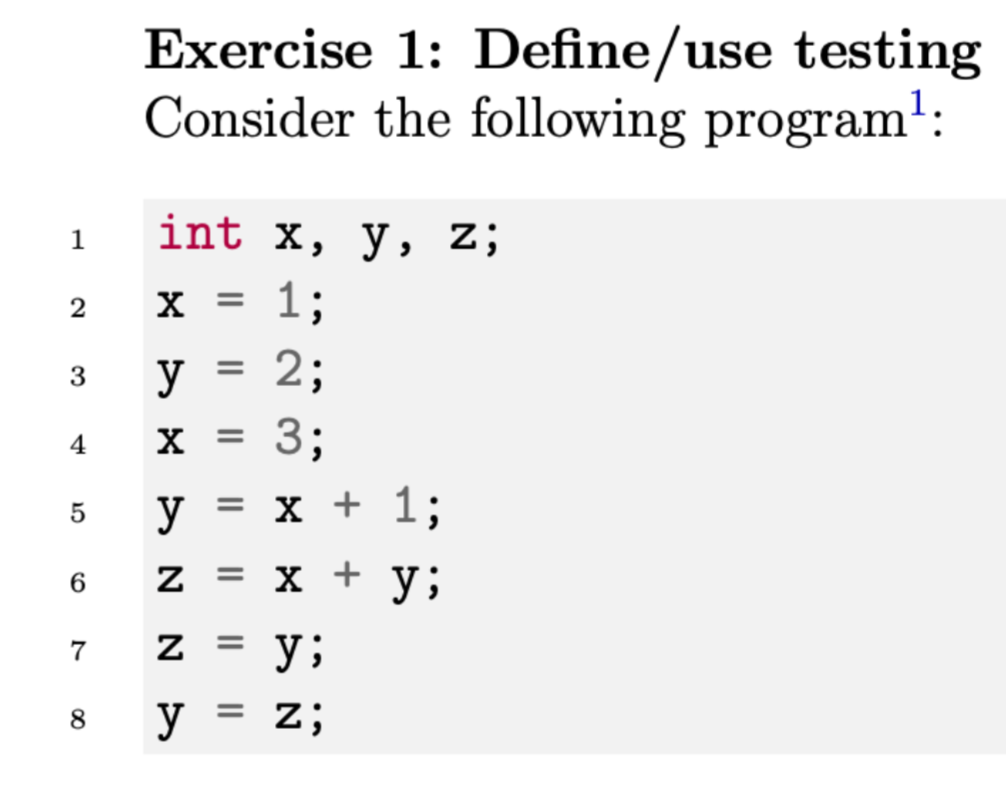
(a) List the statements/nodes n:
For the given program, analyzing each line:
-
DEF(x, n): n ∈ {2, 4}
- Line 2:
x = 1 - Line 4:
x = 3
- Line 2:
-
USE(x, n): n ∈ {5, 6}
- Line 5:
y = x + 1(reads x) - Line 6:
z = x + y(reads x)
- Line 5:
-
DEF(y, n): n ∈ {3, 5, 8}
- Line 3:
y = 2 - Line 5:
y = x + 1 - Line 8:
y = z
- Line 3:
-
USE(y, n): n ∈ {6, 7}
- Line 6:
z = x + y(reads y) - Line 7:
z = y(reads y)
- Line 6:
(b) All DU-paths for variables x and y:
For variable x:
- (4, 5): Path from DEF at line 4 to USE at line 5 (DC-path ✓)
- (4, 6): Path from DEF at line 4 to USE at line 6 via line 5 (DC-path ✓)
Note: DEF at line 2 creates no valid DU-paths because x is redefined at line 4 before any use.
For variable y:
- (5, 6): Path from DEF at line 5 to USE at line 6 (DC-path ✓)
- (5, 7): Path from DEF at line 5 to USE at line 7 via line 6 (DC-path ✓)
Note: DEF at line 3 creates no valid DU-paths because y is redefined at line 5 before any use. DEF at line 8 has no subsequent uses.
All DU-paths are DC-paths in this straight-line program since variables aren’t redefined along these paths.
(c) Implications about assignments in lines 2, 3, and 8:
- Line 2 (x = 1): Dead code - x is redefined at line 4 before being used
- Line 3 (y = 2): Dead code - y is redefined at line 5 before being used
- Line 8 (y = z): Dead code - y is defined but never subsequently used
These assignments are unnecessary and can be removed without affecting program behavior.
(d) Changes with branches and loops:
With branches (if statements):
- Multiple execution paths exist
- Variables may be defined in some branches but not others
- Need to track all possible paths from each definition to each use
- Some paths may be infeasible (logically impossible to execute)
- More complex path analysis required
With loops (while statements):
- Variables can be defined and used multiple times in iterations
- Potentially infinite number of paths
- Must consider 0, 1, or many loop iterations
- Same variable may have multiple reaching definitions
- Need dataflow analysis to handle loop-carried dependencies
Exercise 2: Simple Executable Slicing
(a) S(x, 6) - executable slice:
Working backwards from line 6: z = x + y
- Need value of x at line 6 → defined at line 4
- Need value of y at line 6 → defined at line 5
- Line 5 needs value of x → defined at line 4
- Need declarations
S(x, 6) = {1, 4, 5, 6}
int x, y, z;
x = 3;
y = x + 1;
z = x + y;
(b) S(y, 7) - executable slice:
Working backwards from line 7: z = y
- Need value of y at line 7 → defined at line 5
- Line 5 needs value of x → defined at line 4
- Need declarations
S(y, 7) = {1, 4, 5, 7}
int x, y, z;
x = 3;
y = x + 1;
z = y;
Exercise 3: Slicing
I cannot solve Exercise 3 without access to the referenced book material (Jorgensen’s “Software Testing: A Craftsman’s Approach”, Section 9.2.1, Figure 9.1, and Table 9.5). If you can provide:
- The commission program code or control-flow graph from Figure 9.1
- The slicing criteria from Table 9.5
Then I can compute slices S4, S7, S8, S18, S23, and S37 for you.