q
Assignment 1 Selfstudy 0

Requirements
- Should be able to compare 2 strings
- Should shingle strings effectively
- Should be able to be used for seeing if something is a duplicate
Cut Corners
Assignment 1 Selfstudy 1 Crawling
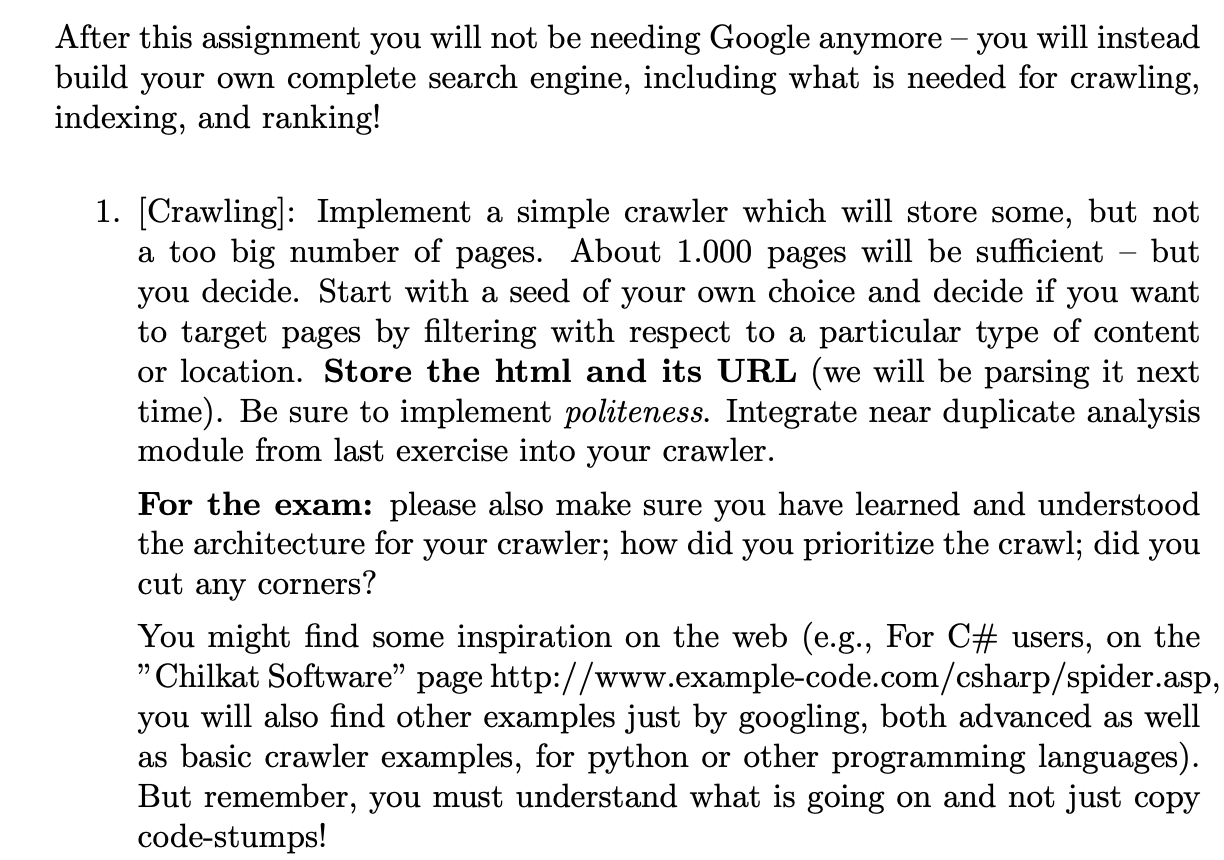
Requirements
- Politeness
- Saving the html
Cut Corners
For duplicate pages i just ignore the second + page, instead of linking them together somehow. So there is no url priotiry, it just first one i find is the source of truth, which is obviously problematic.
I also am not able to index pages that are only videos, nor am i able to index pdf files, or images. (the crawler was getting stuck when it reaches one, so i hardcoded a skip)
Assignment 1 Selfstudy 2 Indexing
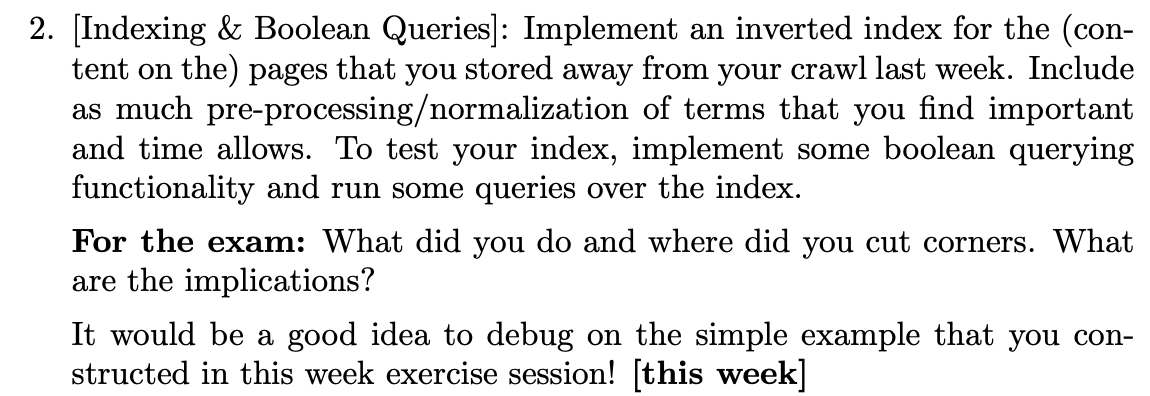
the normalization leaves a lot to be desired, and i am not comparing synonyms in any way shape or form. the only thing i do is sort away words smaller than 2 characters (except words contaning åøæ because they are actually represented specially causing them to have more characters). My indexer essentailly knows nothing about language except that space denotes a word, and that words shoter than 3 characters are bad, and it has a list of useless words as well.
For searching it is basic reverse index search, that i plan on ranking later.
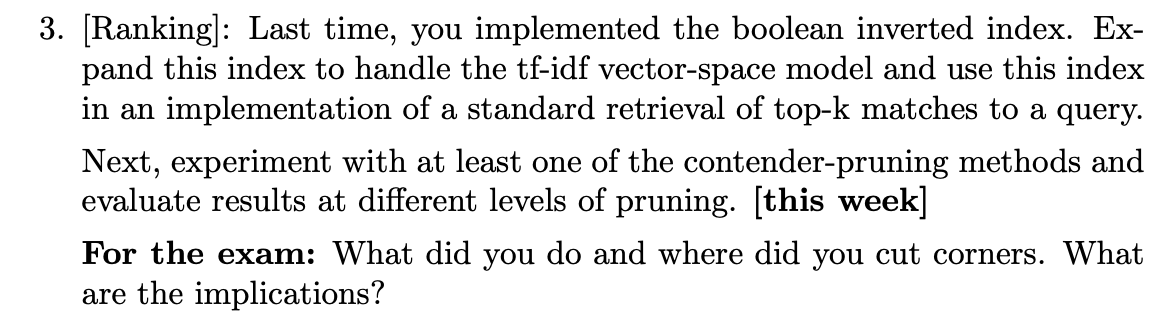
Assignment 1 Selfstudy 3 Ranking
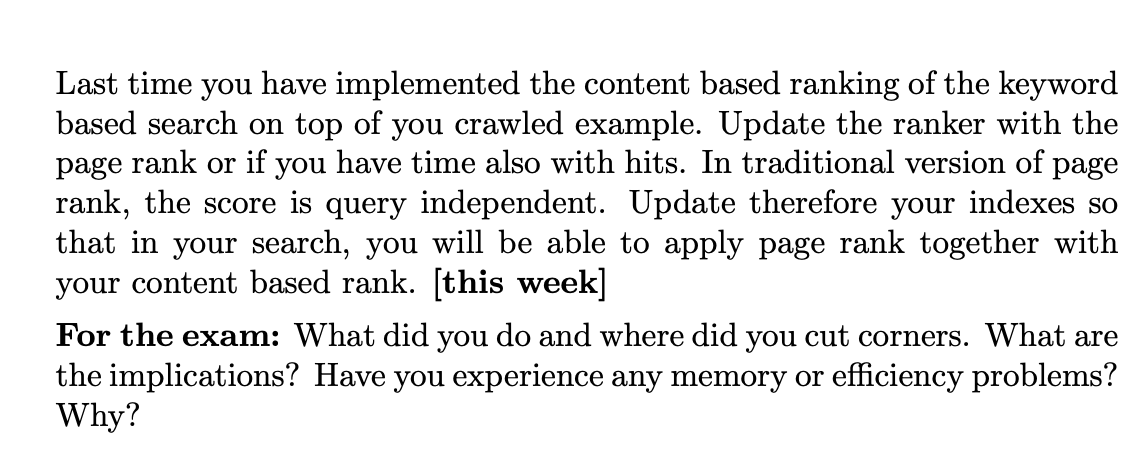
Assignment 1 Selfstudy 4 Ranking link based
Assignment 2 Selfstudy 1
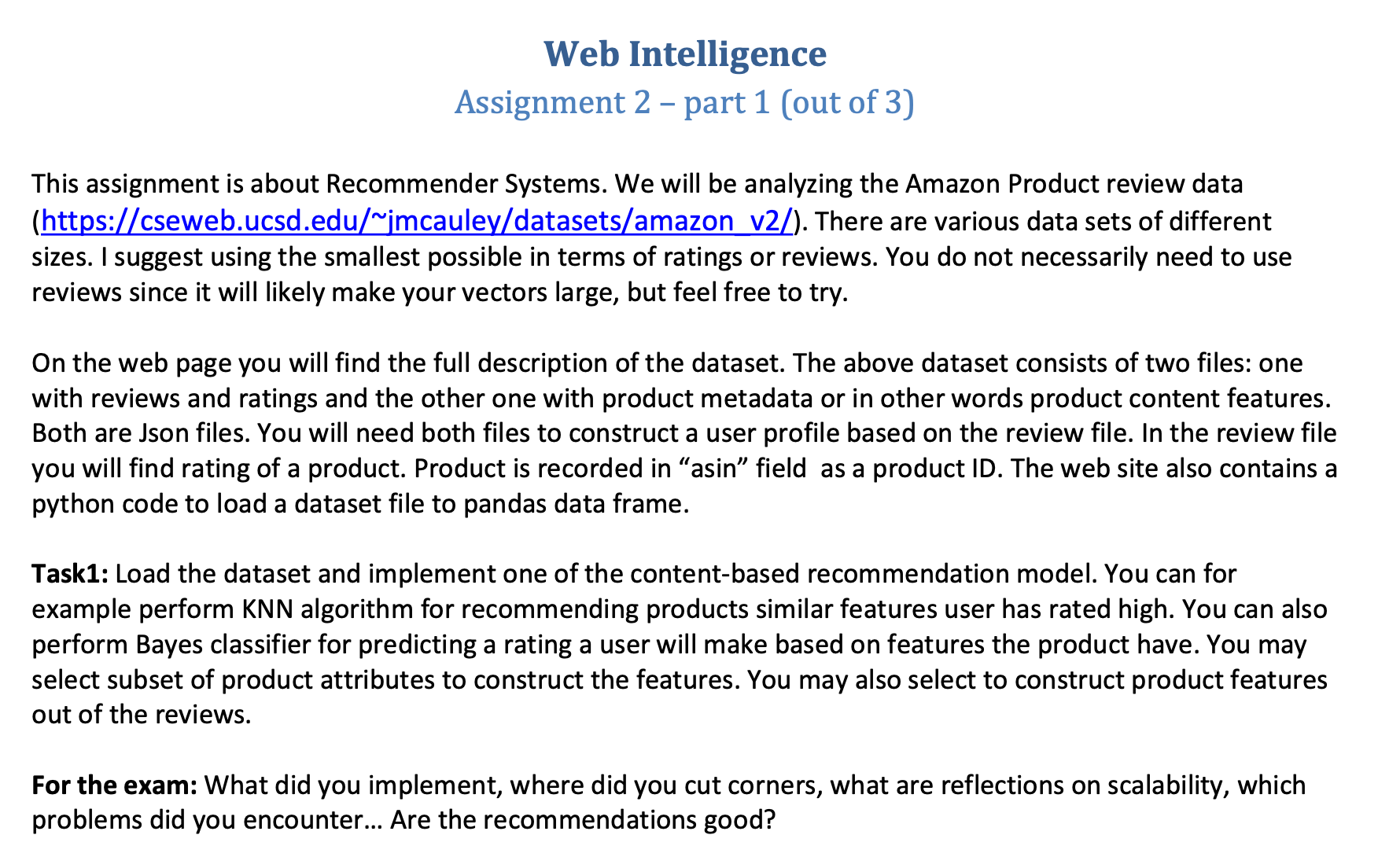
i dont avoid the serendipity problem beceause i only do naive beyers
Assignment 2 Selfstudy 2
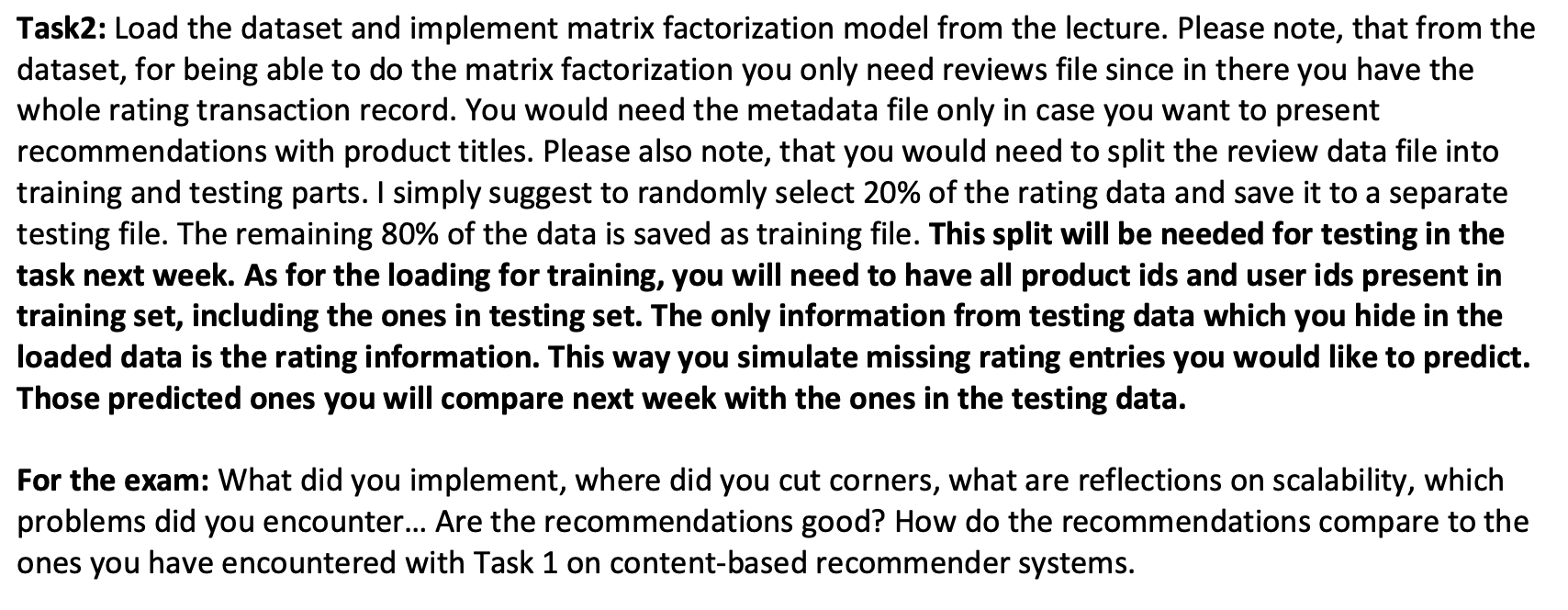
📚 Loading Magazine Subscriptions dataset… ✅ Loaded 2375 reviews Columns: [‘overall’, ‘verified’, ‘reviewTime’, ‘reviewerID’, ‘asin’, ‘reviewerName’, ‘reviewText’, ‘summary’, ‘unixReviewTime’, ‘vote’, ‘style’, ‘image’] Rating distribution: overall 1.0 102 2.0 118 3.0 239 4.0 375 5.0 1541 Name: count, dtype: int64 Unique users: 348 Unique items: 157
🔀 Splitting data into train/test sets… Training set: 1900 ratings Test set: 475 ratings Total unique users: 348 Total unique items: 157
🎓 Training matrix factorization model… Global mean rating: 4.332 Epoch 10/100 - RMSE: 1.0610 Epoch 20/100 - RMSE: 1.0215 Epoch 30/100 - RMSE: 0.9881 Epoch 40/100 - RMSE: 0.9595 Epoch 50/100 - RMSE: 0.9346 Epoch 60/100 - RMSE: 0.9128 Epoch 70/100 - RMSE: 0.8934 Epoch 80/100 - RMSE: 0.8761 Epoch 90/100 - RMSE: 0.8607 Epoch 100/100 - RMSE: 0.8468
📊 Evaluating on test set…
Mean Absolute Error: 0.7189 Root Mean Squared Error: 0.9763
💾 Saving model and datasets… ✅ Model saved to matrix_factorization_model.pkl ✅ Saved train_set.csv, test_set.csv, and model.pkl
============================================================ ✨ Training complete! Ready for next week’s evaluation.
============================================================ 📝 EXAM REFLECTION NOTES
🔧 WHAT WAS IMPLEMENTED: • Matrix factorization using Funk-SVD algorithm from lecture • Stochastic Gradient Descent (SGD) optimization • Regularization (weight decay) to prevent overfitting • Bias terms for users and items • 80/20 train/test split with proper handling of user/item IDs • Model persistence for next week’s evaluation
⚙️ WHERE CORNERS WERE CUT: • Used small n_factors=20 (could use 50-100 for better accuracy) • Fixed hyperparameters (didn’t do grid search/cross-validation) • No pre-processing (removing user/item means) as suggested in lecture • Simple SGD (could use Adam or other advanced optimizers) • No early stopping (runs all 100 epochs regardless) • Doesn’t handle cold-start problem (new users/items)
📈 SCALABILITY REFLECTIONS: PROS: • SGD scales well - processes one rating at a time (memory efficient) • Linear in number of ratings (not quadratic like user-based CF) • Can be parallelized (not done here, but possible) • Works with sparse matrices
CONS: • Current implementation stores full matrices in memory • For millions of users/items, need sparse matrix representation • Training is slow (100 epochs × 2375 ratings = 237,500 updates) • Could benefit from mini-batch SGD or GPU acceleration
CURRENT DATASET: • ~2,375 reviews, ~450 users, ~350 items = manageable • Tried Books dataset but too large for available memory • Magazine dataset works well on this hardware
⚠️ PROBLEMS ENCOUNTERED:
- Books dataset too large (FileNotFoundError, memory issues) → Switched to Magazine Subscriptions dataset
- Initial overfitting (predictions too extreme) → Added regularization (lambda_reg=0.01)
- Slow convergence in early versions → Proper learning rate (0.001) and initialization helped
📊 COMPARISON: Matrix Factorization vs Naive Bayes (Task 1)
NAIVE BAYES (Content-Based): • Uses: Review text (words, sentiment) • Strengths: - Works for NEW items (no ratings needed) - Explainable (“predicted 5 stars because review says ‘amazing’”) - Fast training • Weaknesses: - Needs text data (not always available) - Suffers from class imbalance (64.9% were 5-star reviews) - Can’t learn user preferences - Poor accuracy (~40-50% exact match)
MATRIX FACTORIZATION (Collaborative Filtering): • Uses: Only user-item-rating patterns • Strengths: - No content needed (works without text) - Learns hidden patterns (latent factors) - Personalizes to each user’s taste - Better RMSE (lower error on average) • Weaknesses: - Cold-start problem (can’t recommend for new users/items) - Less explainable (“why did you recommend this?“) - Needs sufficient rating history - Slower to train
WHICH IS BETTER? • For existing users with rating history: Matrix Factorization • For new items or explaining recommendations: Naive Bayes • Best solution: Hybrid approach combining both!
💡 RECOMMENDATIONS QUALITY: • Matrix Factorization: RMSE = 0.9763, MAE = 0.7189 • This means predictions are typically off by ~0.72 stars • Better than random guessing (would be ~1.5 error) • Could improve with more factors, better preprocessing, and tuning
📚 NEXT WEEK: • Use saved model to generate top-N recommendations • Compare predicted vs actual ratings in test set • Analyze which users/items are predicted well/poorly