Key Concepts for Exam question:
- Decidable: A language has an algorithm that always halts and answers “yes” or “no”.
- Recognizable (RE): A language has an algorithm that halts on “yes” instances (may loop on “no”).
- : Problems solvable in polynomial time.
- : Problems verifiable in polynomial time (or solvable with a polynomial-time “lucky guess”).
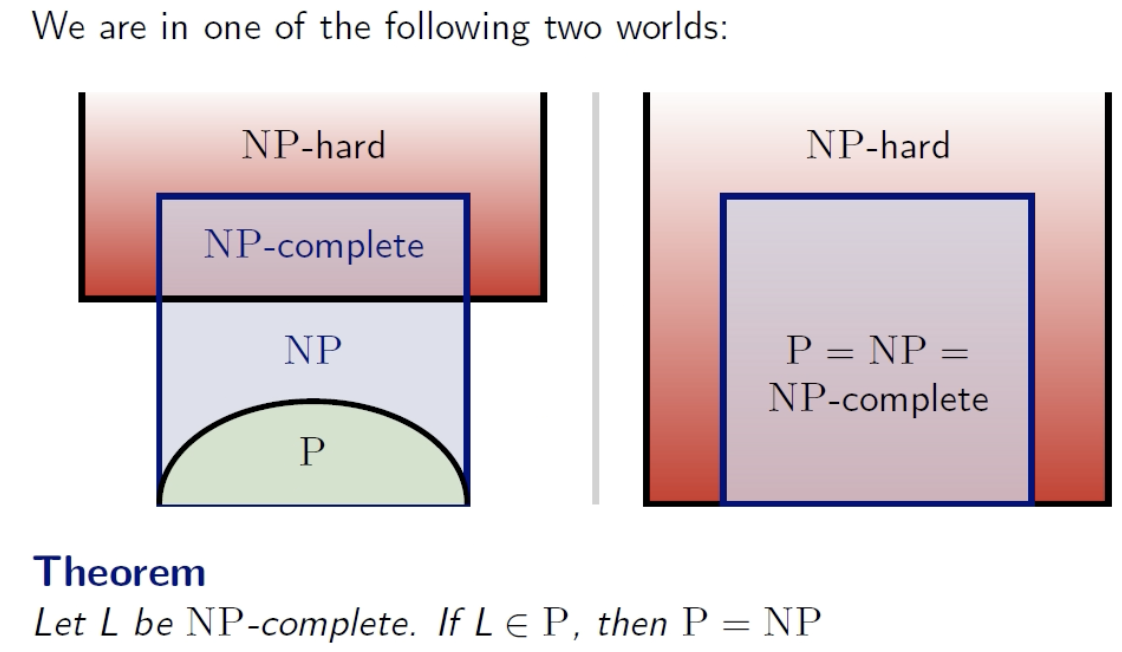
- -hard: Problems at least as hard as all problems in (if , these aren’t in ).
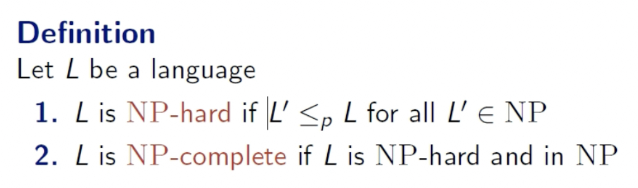
np is hard if lprime is in np.
Key Relationships:
- Reductions:
- If :
- ⇒
- is -hard ⇒ is -hard
- If :
- Hierarchy:
- Decidable Recognizable
- -hard + ⇒ -complete.
Language Analysis:
Given:
- (SAT reduces to )
- is -hard, not in
- Unknown: Decidability, membership
Conclusions:
- Decidable? ❓
- -hardness ≠ decidability (undecidable problems can be -hard).
- Recognizable? ❓
- Recognizability depends on decidability.
- ? ❓
- -hardness ≠ membership (unless ).
- In ? ❌
- -hard + ⇒ .
Given:
- Known: Decidable, in
- Unknown: -hardness, membership
Conclusions:
- Decidable? ✅
- All languages are decidable.
- Recognizable? ✅
- Decidable ⇒ Recognizable.
- ? ✅
- () ⇒ .
- -hard? ❓
- Reduction direction: ⇒ isn’t necessarily -hard.
Given:
- Two deciders (: , : )
- Known: Decidable, in
Conclusions:
- Decidable? ✅
- Explicitly stated.
- Recognizable? ✅
- Decidable ⇒ Recognizable.
- ? ✅
- ⇒ .
- -hard? ❌
- If and ⇒ isn’t -hard.