Exercise 1
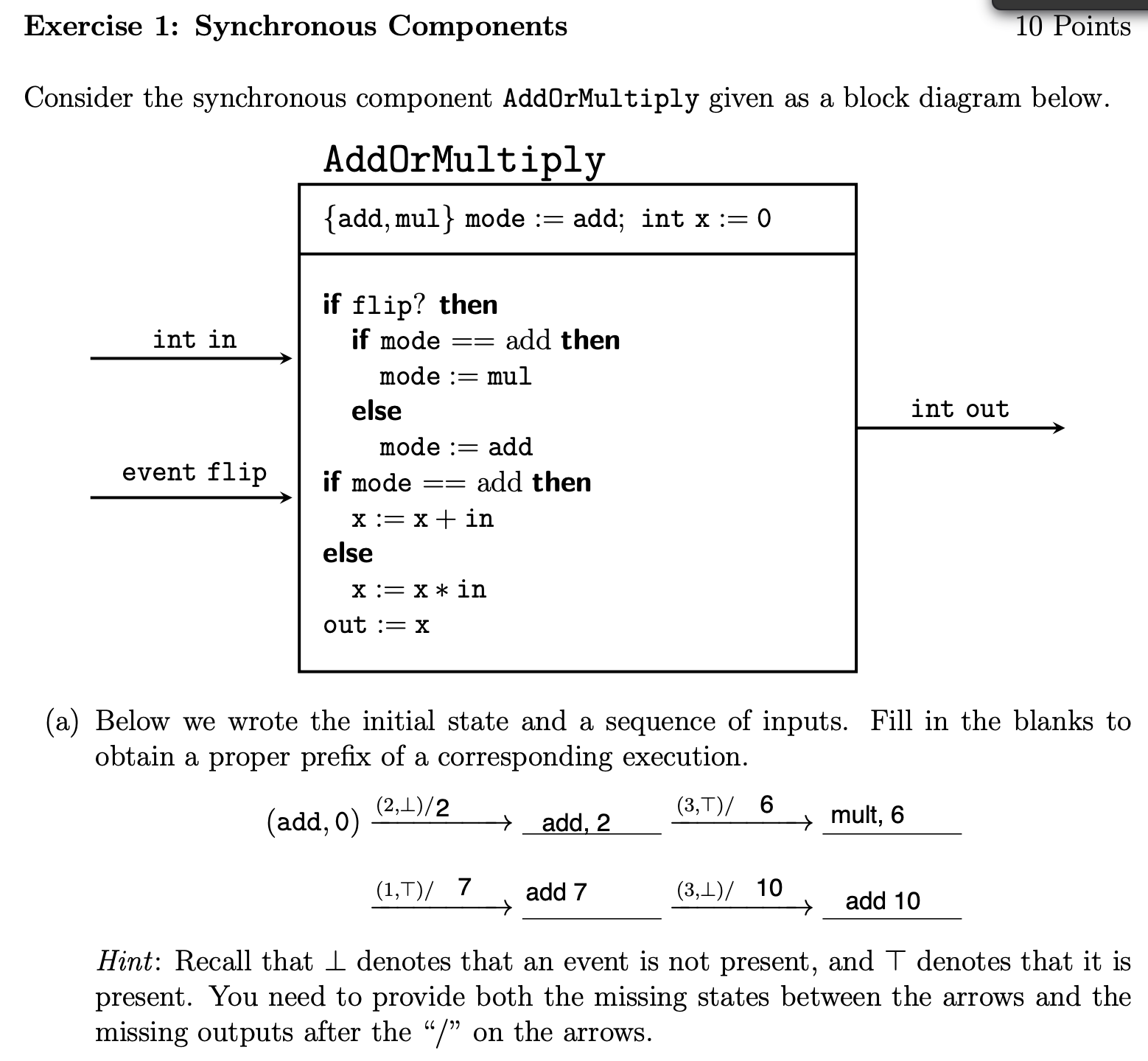

⊥, 21 → ⊤, 2.

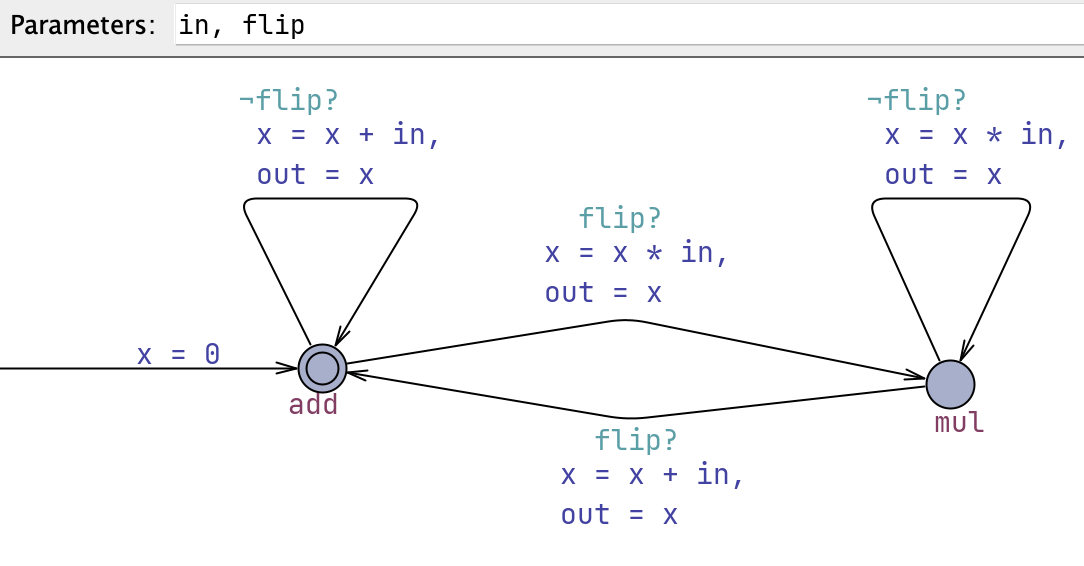
Exercise 2
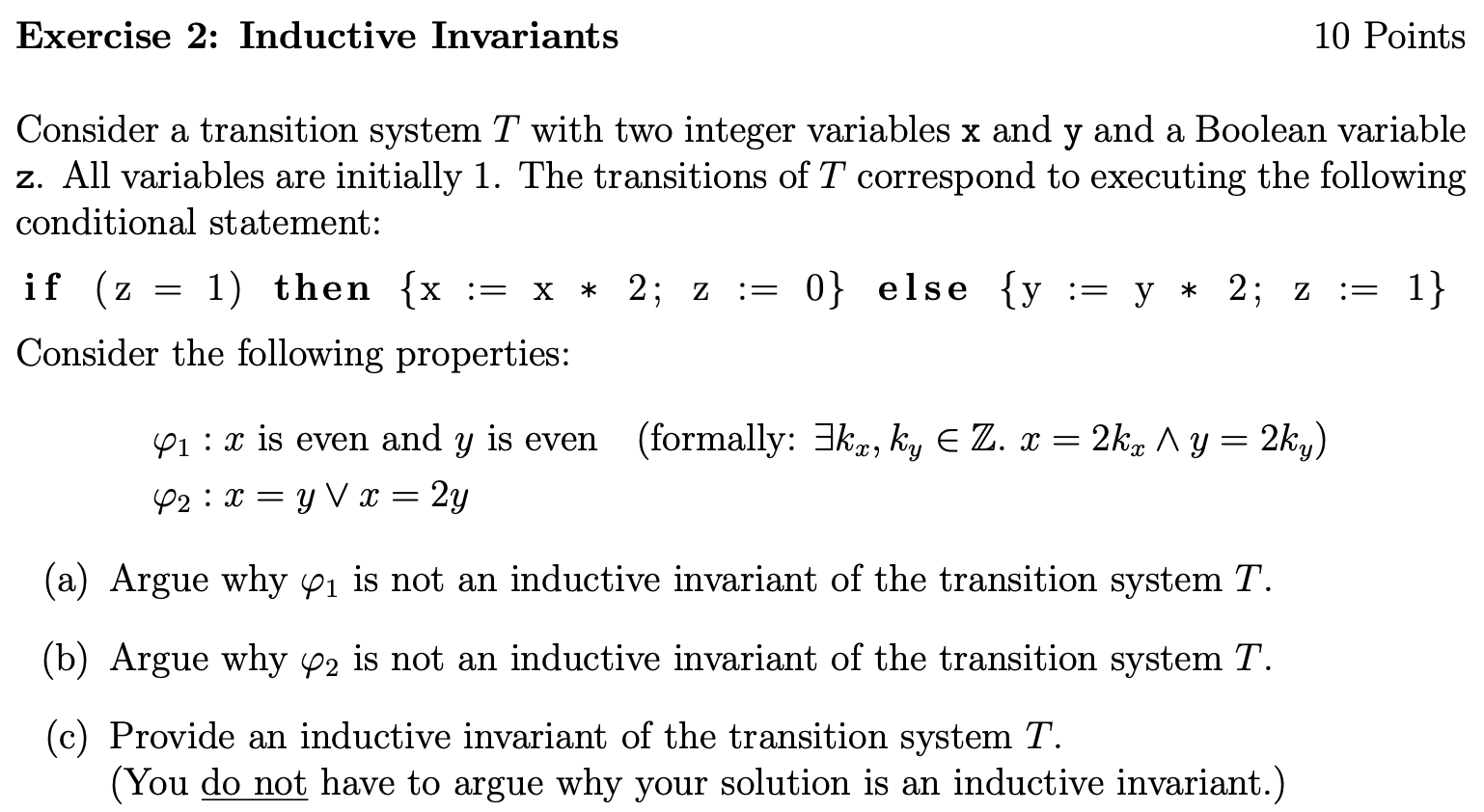 A)
Because they arent even in the initial state. he made a mistake in Session 3 Safety requirements (part 1) part 3 because he forgot about the initial state.
A)
Because they arent even in the initial state. he made a mistake in Session 3 Safety requirements (part 1) part 3 because he forgot about the initial state.
B) Either x and y are the same, or x is twice as large as y.
C)
(x = y ∧ z = 1) ∨ (x = 2y ∧ z = 0)
Exercise 3
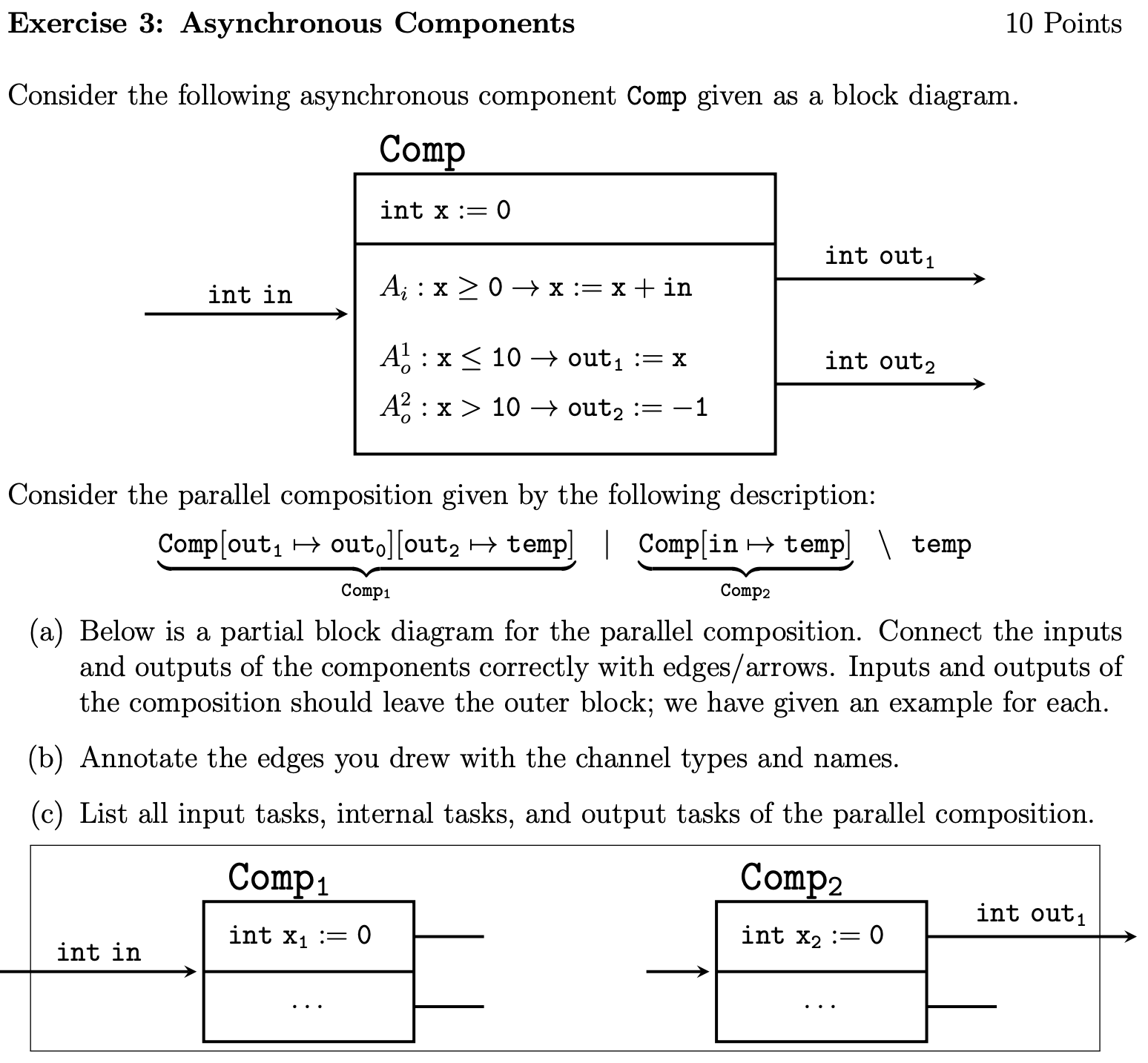
A) and B)
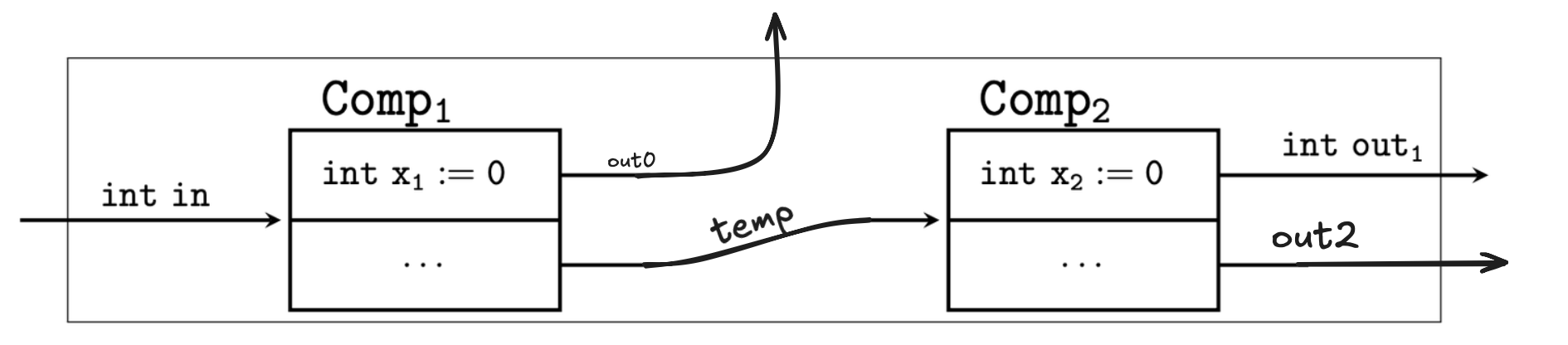
C)
Input:
- Ai: x1 >= 0 ⇒ x1 := x1 + in
Internal:
- At: x1 > 10 ∧ x2 ≥ 0 → {temp := −1; x2 := x2 + temp}
Output:
- A1o: x1 ≤ 10 → out0 := x1
- A2o: x2 ≤ 10 → out1 := x2
- A3o: x2 > 10 → out2 := −1
Exercise 4
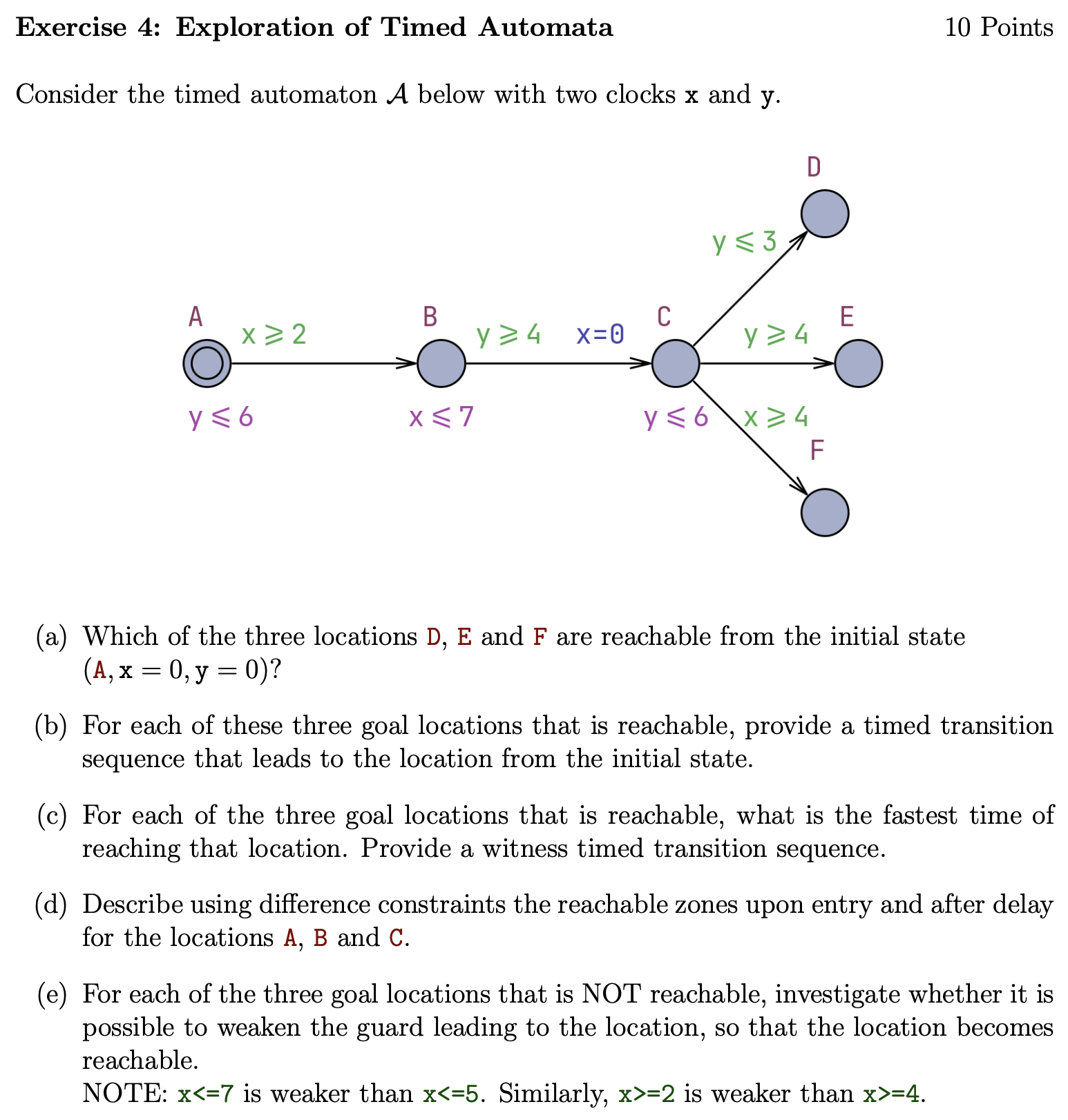
a) Only E is reachable because in D y needs to be 3 but it is at least 4, and in F for x to reach 4 y would need to be 8, but the invariant says we need to leave on or before y reaches 6.
b) (A, x = 0, y = 0) 2 → (A, x = 2, y = 2) → (B, x = 2, y = 2) 2 → (B, x = 4, y = 4) −→ (C, x = 0, y = 4) −→ (E, x = 0, y = 4)
c) 4.
d)
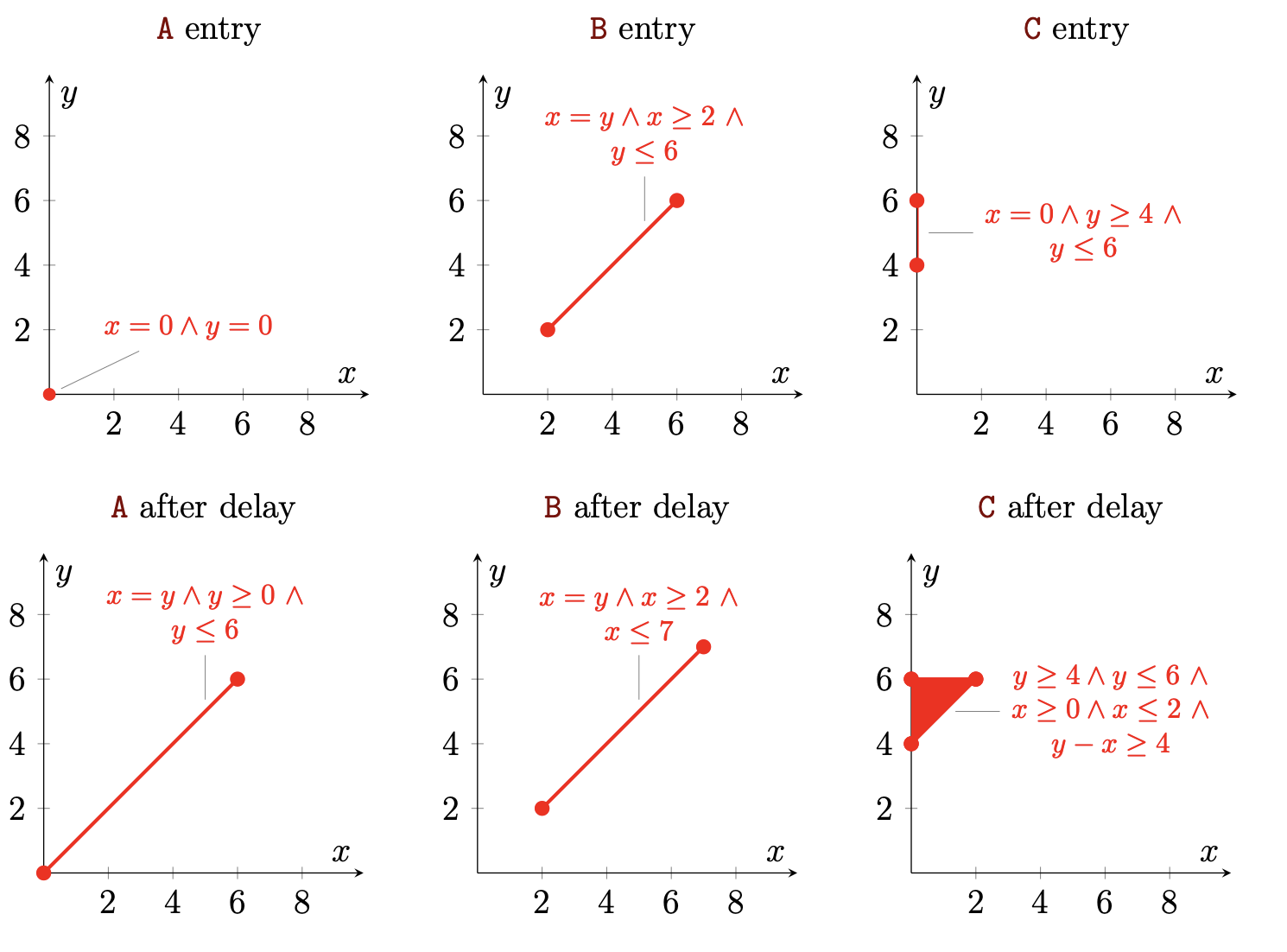
e)
Changing the guard to y ≤ 4 will make D reachable. Changing the guard to x ≥ 2 will make F reachable.
Exercise 5
#!/bin/python3

import matplotlib.pyplot as plt


def f(x, t):
    # Implements the simplified quadcopter model
    m = 0.5
    g = 9.81
    kp = 10
    r = 0.0

    der_v = -g +  (1/m)*x[0]

    # You should return an array of state derivatives
    return [...]


def main():
    x0 = [0, 0]  # Initial state
    t0 = 0  # Initial time
    T = 10  # Time horizon

    fig, ax = plt.subplots()
    experiment(x0, t0, 0.01, T, ax)

    ax.set_xlabel("t")
    ax.legend()
    plt.show()


# -------------------------------------------------------
# Code below does not need to be changed during the exam.
def runge_kutta_4(f, x0, t0, h, N):
    t = [t0]
    result = [x0]
    for i in range(N):
        xi = result[-1]

        k1 = f(xi, t[-1])
        k2 = f(extend(xi, h/2, k1), t[-1] + h/2)
        k3 = f(extend(xi, h/2, k2), t[-1] + h/2)
        k4 = f(extend(xi, h, k3), t[-1] + h)
        step = []
        for j in range(len(xi)):
            step.append(xi[j] + h/6 * (k1[j] + 2*k2[j] + 2*k3[j] + k4[j]))
        result.append(step)
        t.append(t[-1] + h)
    return t, result


def extend(x, h, der):
    assert(len(x)) == len(der)
    result = []
    for j in range(len(x)):
        result.append(x[j] + h * der[j])
    return result


def convert(data):
    result = []
    for i in range(len(data[0])):
        result.append([])

    for x in data:
        for i in range(len(x)):
            result[i].append(x[i])
    return result


def experiment(x0, t0, h, T, ax):
    N = round(T / h)
    t, result = runge_kutta_4(f, x0, t0, h, N)
    result = convert(result)
    for i in range(len(result)):
        if i == 0:  # Only plot state 0, which is the height.
            ax.plot(t, result[i], label=f's[{i}](t)')


if __name__ == '__main__':
    main()