UPPAAL Model Notes #UPPAAL uppaal
UPPAAL Model Notes
Queries Explained
-
E<> (counter >= 70 && hit == 13)- Checks if there exists any path where eventually:
counter≥ 70 (global tick counter)hit= 13 (worker’s “hit” counter).
- Checks if there exists any path where eventually:
-
A[] !(P1.Crit && P2.Crit)- Ensures for all paths, P1 and P2 are never simultaneously in their critical sections (mutual exclusion).
-
A[] not deadlock- Verifies the system never deadlocks (always has an enabled transition).
-
P1.Try --> P1.Crit- Whenever P1 enters
Trystate, it eventually reachesCrit(liveness property).
- Whenever P1 enters
Also look at Temporal Logic and Set-Builder Notation Reference it is slightly related.
Ticker Template
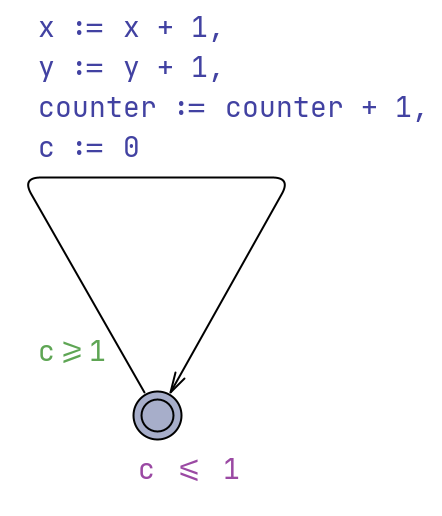
Declarations:
clock c;        // Local clock
int x = 0;      // Incremented every tick
int y = 0;      // Incremented every tick
int counter = 0; // Global tick counter
Behavior:
- Invariant:
c <= 1(forces transition whenc=1). - Transition: Triggered when
c >= 1:x := x + 1,y := y + 1,counter := counter + 1- Reset:
c := 0(ensures continuous ticking).
Purpose: Synchronizes global increments and resetscto avoid overflow. (it is probably a stupid solution, but it works)
Worker Template
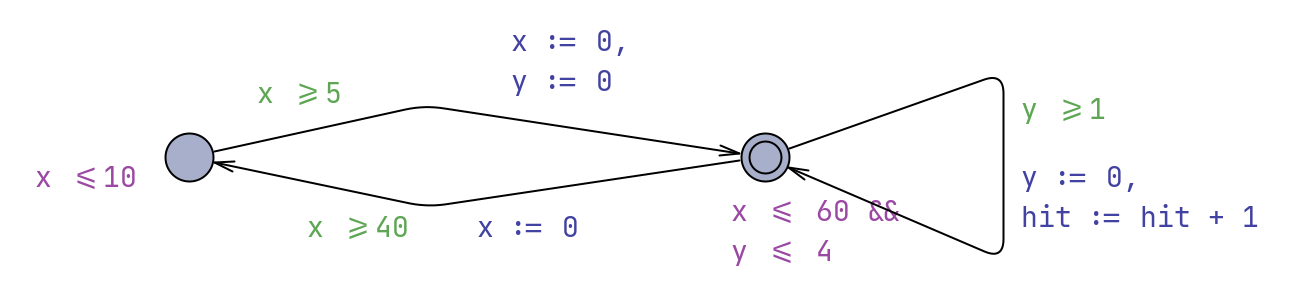
Key Concepts:
- Invariant: Condition that must hold while in a location (e.g.,
x <= 10inid2). Violation forces a transition. - Guard: Condition enabling a transition (e.g.,
y >= 1). Acts like anifstatement. - Sync: Not used here; processes run independently. explain this better
- Update: Code executed during a transition (e.g.,
y := 0, hit := hit + 1).
Locations:
id3(Initial):- Invariant:
x <= 60 && y <= 4(limitsx/y). - Loops if
y >= 1→ resetsy, incrementshit. - Moves to
id2ifx >= 40→ resetsx.
- Invariant:
id2:- Invariant:
x <= 10. - Returns to
id3ifx >= 5→ resetsxandy.
- Invariant:
System Setup
W = worker();   // Worker instance
T = ticker();   // Ticker instance
system W, T;    // Parallel composition
Why: Runs worker and ticker concurrently.
Location Properties
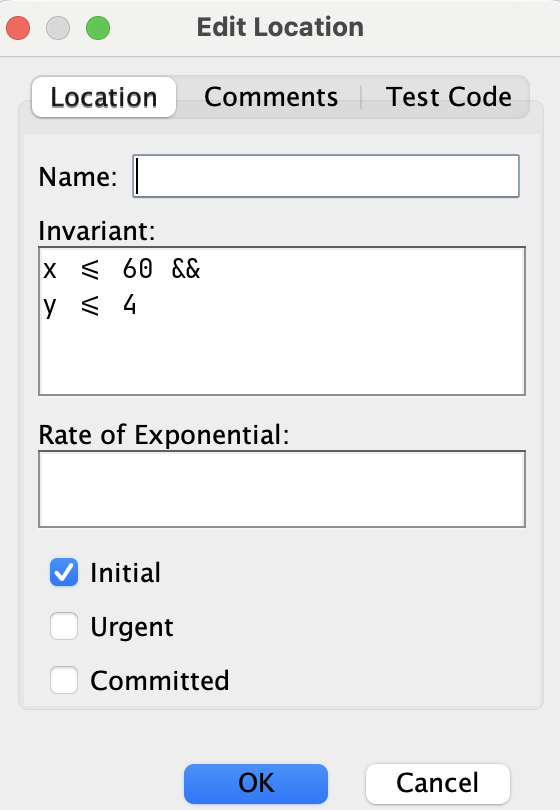
- Initial: Starting state (e.g.,
id3for worker). - Urgent: Forces immediate transition if enabled (time cannot pass).
- Committed: Halts time; no other process can act until transition is taken.
(Not used in this model.)